I wish I could write more often, 3 or 4 hours daily. Writing is good for healing, and maybe it can be a productive job.
However, it is not easy to build a strong commitment to an activity that absorbs quite a lot of time and lets me fall deep into it. Moreover, I am still an office worker with many tasks and responsibilities.
I don’t need to say how tired I am after returning from the office. The work and traffic jams on my way to and from the office leave me exhausted. Once I get home, all I want to do is lie down or scroll through my mobile phone. Before I realize it, night has fallen, and I am on my way to sleep.
There is still hope. Soon, I will have more free time. I plan to leave my current job and become a lecturer. The roles of a lecturer and a writer are closely related, and I am enthusiastic about pursuing both shortly.
My friend Lily (not her real name) is the most confident friend I have ever had. The way she speaks in public amazes everyone and makes them believe in her reputation as a senior government official.
Indeed, she has worked for years in the field. No wonder she understands and can provide quick responses to pressing problems.
I admired her confidence and even felt a bit inferior to her greatness. Until one day…..
She chatted about the complicated problems in her household and the pressure she faced from the boss. That I thought was worth confronting, but she chose to compromise.
I learn a lot from her. Confidence does not mean that someone can really control their own life. Someone who looks so confident on the surface may just be acting. But in reality, they are hiding worries that would destroy themselves.
I am not always confident in myself. I am grateful for that. I tend to be quiet and less vocal about my work achievements. The benefits are great, you know. I can live more peacefully because not many people look at me or are jealous of my life.
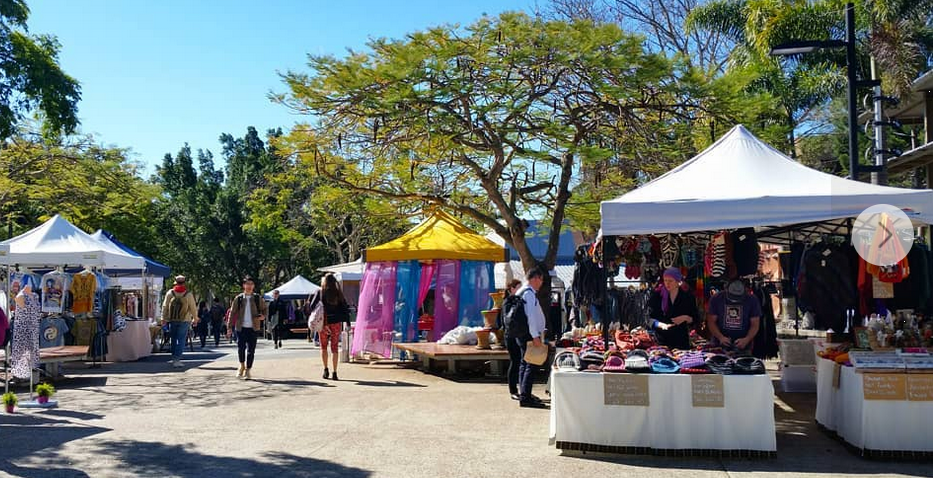
One memorable activity during my studies in Australia was shopping for second-hand books in the courtyard of the University of Queensland. The flea market there was known as Wednesday Market. That’s the hunting place to get lower prices for books, fresh flowers and food.
The place was a favorite of all students. I can still clearly remember the atmosphere every Wednesday. Dozens of stalls with canvas tents stood, selling books, flowers, sketches, ceramic and wool dolls, etc. On the side of the road were lined with Jacaranda trees for shade. Its lavender-blue flowers were scattered on the road throughout April to August.
As foreign students with limited pocket money, we had to be frugal while pursuing our passion for exploring many places and gradually collecting souvenirs to bring back to Indonesia.
Shopping here felt like an extravaganza for me. I enjoyed walking around the booths and choosing classic novels, history books, and other things that took my attention. I didn’t invite anyone to join me, in worry that my concentration would be divided when choosing books.
Over the course of nearly a year and a half, I collected a substantial number of books. I had to pay for cargo rental to bring them back to Indonesia, which I cost-shared with friends with the same interest.
The books only cost me 5 cents, or at most 1 dollar, but I felt very lucky to have them. They are my precious collection.
A superstitious figure in the sea off Java Island. She is believed to be the protector of the people. Every year, a ceremony is held to deliver offerings to the queen of the southern sea.
In some areas in my country, traditions mixed with superstition still exist, even becoming tourist attractions and annual agendas.
However, some people see it only as mere culture (traditional clothing, dances, and rituals). So when they come to activities that have elements of superstition, they only want to immortalize the moment with photos or videos,
The values of superstition and religion are contradictory. Pious people avoid doing superstitious things. However, the tourism industry does not recognize the term superstition. If an event can attract thousands of people, they will manage it for money.
At the popular tourist agenda of offering to Nyi Roro Kidul on the South Coast of Java Island – as an example, many religious people also gather. They come as groups that organize events, sell food, offer souvenirs, and provide other services.
Well, in such conditions, superstitious activities can be economically beneficial.
The shopping spree is no longer a pleasure. I have been away from it for a few years. I feel it is a waste of time, giving me only a momentary pleasure. I now live a slow life, where simplicity is an integral part of it.
Are you familiar with the economic concept known as the Law of Diminishing Returns? I apply this concept to remind myself to be more economical. How can I interpret this law to help control my shopping habits?
I use the analogy below:
If I bought a classy and expensive dress for the first time, my pleasure was expressed as 100%.
When I bought a second dress, did my pleasure become 200%? No, my pleasure might only reach 170%, a decrease of 30% in pleasure for the second item I bought.
And so on. The more I shopped, the less pleasure I felt. I lost, right? My money was reduced. I gave it to the boutique owner.
When I heard the law of diminishing returns, I related it to my own experience. True, pleasure decreases as things become easy to achieve or I have more stuff.
If you want maximum pleasure, choose one thing that you need and love the most. Guaranteed, your pleasure will reach 100%.
You may have a different opinion about this topic. It’s interesting to hear your side.
It’s hard to answer this question. Frankly, I have no plan yet to write an autobiography.
I understand that most readers judge a book from the first page before deciding whether to continue reading or stop immediately. If I start writing an autobiography, the opening sentence must be interesting and invite the reader to continue reading.
It is unusual to write a surprise at the beginning of a book. For example, a description of the incident before I entered the operating room and the anxiety of my family members at that time. Isn’t it strange if a sentence like this is in the first paragraph?
It’s better if I write the opening sentences with a strong message. It may be like this.
Most people who first meet me assume that I am a soft obedient woman, motherly, the ideal woman for men who adhere to patriarchal beliefs.
However, that is not entirely true. My life journey for the past 45 years has taught me that each woman has her own character. That prototype is wrong.
Both struggle and destiny shape a person’s future. I believe this not only because of cultural or religious teachings but also because I have experienced it myself.
For approximately 40 years of my life as an adult, I have learned how to work, study, and adapt well to the surrounding environment. In some cases, I was able to achieve the expected results, but in others, I failed. Destiny is the determining factor.
Destiny plays a role in determining the results of efforts, but it also plays a role in other things. For example, meeting someone I had not planned changed my views or decisions about something.
I believe that humans cannot fully define their true selves. The combination of excess personal traits, opportunities, varying environments, and other unseen factors influences their direction in life.
In Islam, there is good advice about struggle and destiny.
Develop the mindset of Tawakkal in you. Tawakkal means surrendering all affairs to Allah SWT after trying your best.
Tawakkal will empower you, restoring your energy to fight and instilling the belief that a better fate awaits you somewhere in the future.
To all my friends fasting this month of Ramadan, I wish you the best of luck. Have a great weekend, all my readers.
Don’t expect to find true friends at work; they usually don’t exist. Instead, you may encounter two-faced individuals who act like enemies.
Who wants to be a scapegoat? All the blame is placed on him, even though he has worked well, but is not considered.
I certainly don’t want to.
Someone who is in the position of a scapegoat must have experienced tough and stressful days. No matter how loud he shouts, the people around him do not respond positively.
In the workplace, unhealthy competition often occurs. Coworkers may undermine one another due to ambitious motives or claim credit for others’ work as their own success, which is unfortunately common.
Don’t expect to find true friends at work; they usually don’t exist. Instead, you may encounter two-faced individuals who act like enemies.
Maybe that expression is too harsh, but it is to remind you that office friendships are fake. Don’t bring friendship in the office into your personal space. It can reveal your weaknesses in front of people whose sincerity has not been tested.
In an unfair situation, there are several steps to deal with it.
Stay calm and professional.
Gather evidence to support your argument.
Communicate your concerns to your boss or coworkers.
Seek support from coworkers or mentors who can help you deal with the situation.
If circumstances worsen, you may file a formal complaint or seek assistance from a third party.
In addition, you need to increase your authority so that you are not always the victim or scapegoat.
How? Strengthen your integrity as someone honest, transparent, and consistent. People with this character will naturally attract followers who can become your defenders.
Communicate any issues by clearly presenting your accomplishment and supporting evidence, as outlined in your job description. Firmly assert that you should not be held responsible for tasks outside your duties. Remember, you are not expected to handle everything perfectly or possess supernatural abilities.
Face conflict calmly and courageously. This will build itself if you have done the task correctly according to the direction of your superior and coordinated with colleagues. Keep learning to improve the right way to communicate and make past mistakes as a medium for self-improvement.
Character formation begins in childhood, but from my experience, the strongest character formation occurs in adolescence.
As a teenager, I was quite introverted but not rebellious. I shifted from one who spent lots of time playing to a teenager who played less and focused more on my studies. While this shift was beneficial academically, it made me less skilled at building friendships and social connections.
I was easily offended, and that carried over into adulthood. Many of my friendships ended in cold wars. Friends ignored me, only came when they needed help with their lessons, but did not include me in their circles.
Now that I think about it, that attitude was detrimental to me.
Why couldn’t I have been more flexible?
I shouldn’t have been so extreme, even though they acted that way. After all, not all aspects of their personalities are bad. I could still find ways to benefit from them, such as enjoying their swimming pool, tasting their cakes, or having them give me a ride home. I realize now that I had very little playfulness in me, which made me vulnerable and easily hurt.
That feeling is still there today but has diminished significantly.
If I could go back in time, in addition to studying hard and developing my interests, I would also develop my ability to build friendships and networks. I would control my inhibiting emotional traits.
It is not an easy decision for one who enters the 40s or 50s. For those who have worked for decades in one place, changing jobs becomes more dilemmatic. Not only salary, work atmosphere, distance from home, acceptance of spouse/children, and so on must also be considered carefully.
Some reasons why someone finally considers changing jobs:
Lack of challenges that cause someone to feel bored and unmotivated.
Lack of opportunities for self-development.
Unsatisfactory salary
Uncomfortable work environment
Changes in life priorities.
Lack of balance between work and personal life
Salary is not the number one factor for those who have accumulated wealth from their previous jobs. They may switch careers to follow their passion or a more relaxed lifestyle. Many have left their jobs to pursue writing, start businesses, or become homemakers.
How do their spouses and children respond? Is it important to consider? Yes, I think. They are the first parties who will feel the impact of the decision. For example, if income decreases, the family must adapt, and you need to discuss the consequences with them.
If your spouse and children are fortunate to be financially independent, at least you tell them that the decision is a need for your soul so that they will support you and not ignore you if unpleasant things happen.
Before deciding to change jobs, someone should consider several things, such as:
Are the reasons for changing jobs strong enough?
Is there a clear career plan?
Do you have enough skills and experience to get the desired job?
By considering these things, someone will be more confident in pursuing their new career.







 my thoughts on the environment, travel and life reflections