I will celebrate Eid al-Fitr this year with different customs. I don’t prepare a lot of food and cakes. No new clothes. No new utensils. This year’s Eid al-Fitr will be very minimalist. I have left behind a cheerful and warm Eid.
Instead, I spend more time praying and doing other good deeds during Ramadhan.
Finally, I have reached a point where Eid al-Fitr feels ordinary. It doesn’t need to be exaggerated; Eid al-Fitr is simply one day at the end of Ramadan.
Without my two children and their families, our house becomes very quiet.
Loneliness will be part of me in the future. This makes me think, what will I use this abundant time for?
The children have their activities. They are competing to achieve their future. I will not ask them to sacrifice their future to live with me. That’s not fair for them.
I must say this; my husband and I will be the past for our children. We have to accept this and be prepared.
My friends, do you feel the same way when your children grow up and no longer live with you? How do you cope with it?
Ramadhan is coming soon. Muslims are making various preparations so that all the necessities and atmosphere in the household support performing prayers and fasting.
Like many generations that lived in the 1970s, I grew up with a simple lifestyle. Unlike today, when I can easily purchase various necessities for the fasting month—such as basic groceries, instant food, Takjil, and more—during my childhood, most of the cooking and baking for breaking the fast or for Eid was done by my mother, with help from other family members.
One thing that stands out to me as Eid approaches is the hustle and bustle at home as we prepare cookies and traditional foods. My mother was the master and trendsetter for cookies in our neighborhood. Almost all the mothers nearby came over to ask, “What cookies are you planning to make for Eid? Do you have any new recipes? Can I borrow the recipe?” They even borrowed cooking utensils from her.
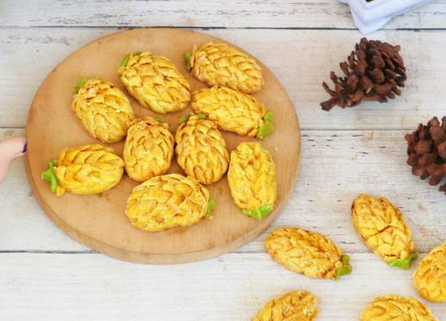
Nastar, the most popular cookies in Eid (The Lebaran Day)
The aroma of cookies could be smelled in the houses and on the streets, especially a week before Eid. That was the challenging time of fasting for kids. Amid their peak hunger, the smell of baking cakes could make them stop fasting.
In my house, there was a custom that all the children had to help make cakes. At that time, four of us were still in elementary school, and the other 2 were still in kindergarten. So, the 4 older children were the ones who had to help Mom.
My mother would start making the dough in the morning. She wanted the kitchen cleaned first. That was my job. My second younger sibling, Win, and the fourth, Doli, would mold and bake the cakes, while my third younger sibling, Cok, would wash all the equipment.
Mother used all her artistic skills to make cakes. Do you know about Nastar cookies? She molded them exactly like mini pineapples. Dad often told her not to do that.
“Appearance isn’t important. The cake will melt in your mouth in seconds.” He advised. However, my mother ignored him. The cake in the jar should look as good to her as it tasted.
After finishing baking, Cok had to wash all the equipment and plates. However, he often forgot and handed over the task to Doli. I complained to Dad because I felt sorry for Doli. He always replaced Cok’s duties, but it seemed that Dad didn’t care anymore.
Cok was the naughtiest child among us. He preferred to collect all the broken or slightly burnt cakes.
“This is still good for breaking the fast,” he suggested.
Although making cakes was a bit tiring, now I remember it as one of the best moments of my childhood. Through this activity, Mom taught us to work together and instilled cooking tasks were not only for women. The impact was positive. My brothers got used to household chores and now do them in their respective families.
Among my 4 brothers, I really appreciated Doli. He was very responsible in his duties, calm and never complained, and very neat. Before he passed away in 2018, I visited his house. His house was very clean and tidy. In his spare time, he was willing to help his wife clean the house and take care of their children. I think the influence of our parent’s home upbringing has made him a good husband and father.
Cok, the naughty child, has changed a lot. Unexpectedly, he is now a hard worker. Several times, I saw him bathing his children with the patience of a mother.
We once talked about the memories of cooking those Lebaran cakes while laughing. That was the childhood habit that united us, and now, just remembering it makes my heart warm, and missing my siblings.
I hope there will be another chance for us to meet. Maybe at one of our children’s wedding parties. The older I get, the more I miss my siblings.
 my thoughts on the environment, travel and life reflections